
Ilya Cech spoke at the TianQin Conference in Singapore
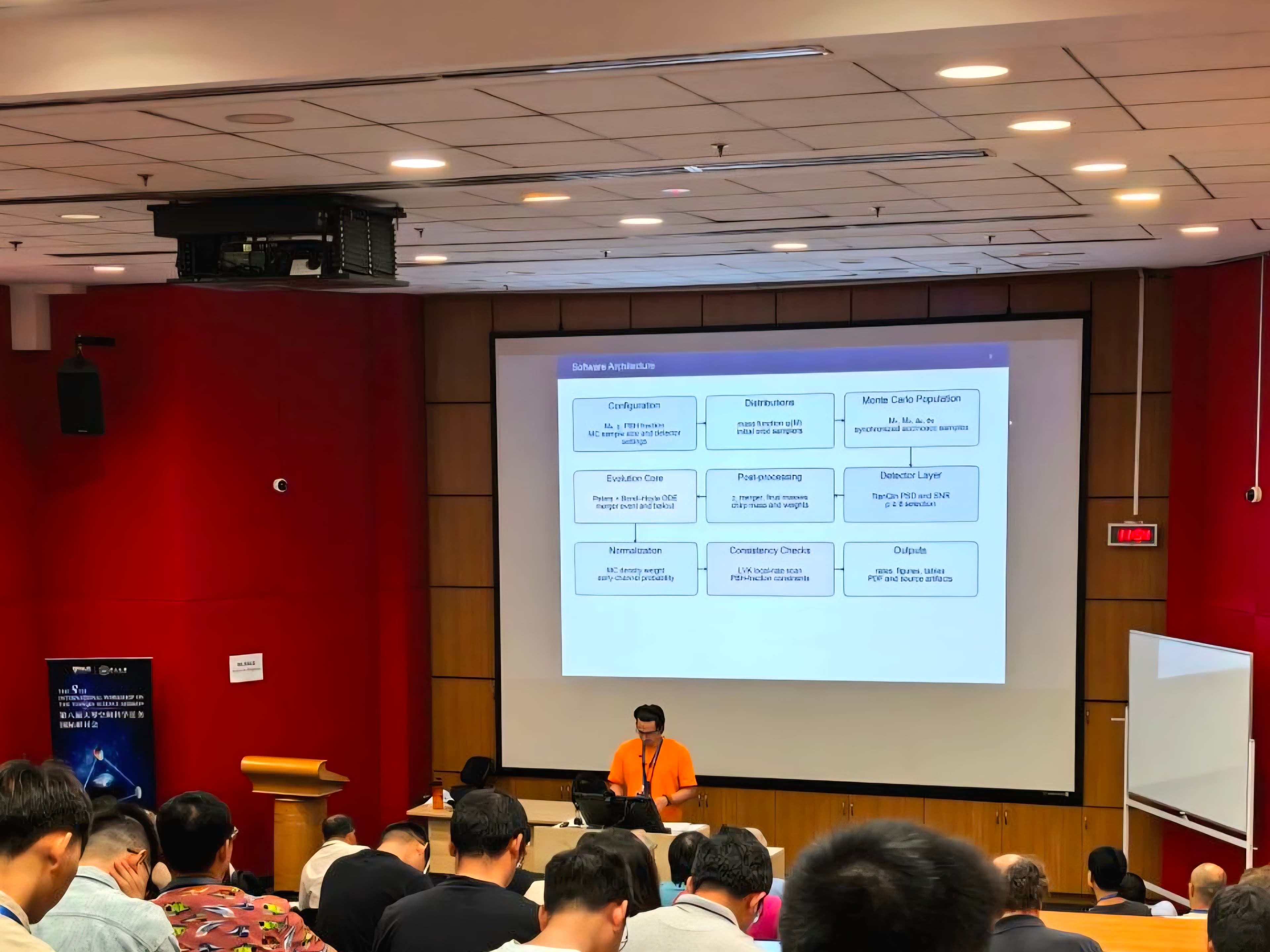
Ilya Cech took part in an international conference dedicated to the TianQin space gravitational wave observatory project. The event was held in Singapore and brought together researchers working in the fields of gravitational-wave astronomy, cosmology, astrophysics of compact objects, modeling of black hole populations and data analysis of future space detectors.
The conference program is published on the official website of the TianQin project.
What is TianQin?
TianQin is a promising space gravitational wave observatory being developed in China. Its task is to register gravitational waves in the millihertz frequency range, which is inaccessible to ground—based detectors like LIGO, Virgo and KAGRA.
While ground-based observatories mainly observe mergers of stellar black holes and neutron stars in the last seconds of their lives, space-based detectors will be able to explore more massive and extended systems: binary black holes of intermediate and supermassive masses, compact objects near massive black holes, as well as possible signals from early The universe.
The TianQin project is among the key future gravitational-wave astronomy tools, along with other space missions such as LISA. Therefore, conferences dedicated to TianQin gather specialists who discuss both the technical aspects of the future observatory and the scientific tasks that it will be able to solve.
Who participated in the conference
The conference was attended by representatives of the international scientific community: astrophysicists, cosmologists, specialists in gravitational waves, researchers of compact objects, developers of source models and experts in data processing.
The discussions focused on the future observational capabilities of TianQin, forecasts for various classes of gravitational wave sources, methods for their detection, as well as the connection of space gravitational wave observations with modern cosmology and black hole physics.
Such meetings are especially important because TianQin is still at the stage of preparation and development. The scientific community is already forming a list of key tasks for the future mission.: which sources will she be able to see, which parameters of the universe to refine, and which new physical effects to test.
The report was devoted to modeling possible sources of gravitational waves that could be detected by a future observatory. TianQin. The research focuses on binary systems of primary black holes of intermediate masses.
Primordial black holes are hypothetical objects that could have formed not as a result of the evolution of stars, but in the early The universe, shortly after the Big Bang. They are considered as one of the possible candidates for contributing to dark matter and as a potentially important source of gravitational wave events.
The main question of the report was as follows: if such black holes really existed in the early universe and formed binary systems, then how many of their mergers can TianQin detect? And how much will this forecast change if we take into account accretion — the increase in the mass of black holes due to the absorption of surrounding gas before the merger?
The main idea of the study
The Monte Carlo method was used in the work: large samples of binary systems of primary black holes with different masses, orbital parameters and conditions of evolution were modeled. Then, for each system, it was evaluated whether a merger would occur and whether such a signal could exceed the detection threshold of TianQin.
A key element of the study was the comparison of two scenarios:
- evolution of binary systems without accretion;
- evolution of binary systems taking into account gas accretion according to the Bondi—Hoyle model.
This comparison allows us to understand whether accretion is a small refinement of the model or a factor that significantly changes the predicted number of events.
The main conclusion of the report: Accretion can significantly enhance the observed signal. It increases the masses of black holes, affects the orbital evolution of binary systems, and increases the likelihood that such objects will fall within the TianQin sensitivity range.
Especially important is the so—called "heavy tail" of the distribution - rare but massive systems. They may make the most significant contribution to the number of potential detections by the space observatory.
Why is this important?
Future space-based gravitational wave detectors will open a window into the frequency range where sources inaccessible to ground-based instruments may be located. Therefore, it is already important to make theoretical predictions: what events can be recorded, how often they will occur, and what physical processes affect their observability.
The study presented by Ilya Cech shows that when evaluating future TianQin detections, it is necessary to take into account not only the initial masses and orbits of binary black holes, but also their subsequent evolution. Accretion can significantly change the final population of sources and affect the number of events that will be visible to the detector.
Such work helps to determine in advance the scientific potential of future missions, refine models of the formation of primary black holes and assess what role they can play in astrophysics and cosmology.
Next steps
The presented report is part of a broader research program. The next stage will be the expansion of the model and a more detailed study of the uncertainty: the distribution of masses of primary black holes, their proportion in dark matter, accretion parameters, velocities, conditions for the formation of binary systems and limitations from existing gravitational-wave observatories.
Participation in the TianQin conference made it possible to present the results to the international scientific community and discuss them in the context of future space gravitational-wave astronomy. Such predictive research is especially important for this field right now: it helps to understand what discoveries may become possible after the launch of new generations of detectors.